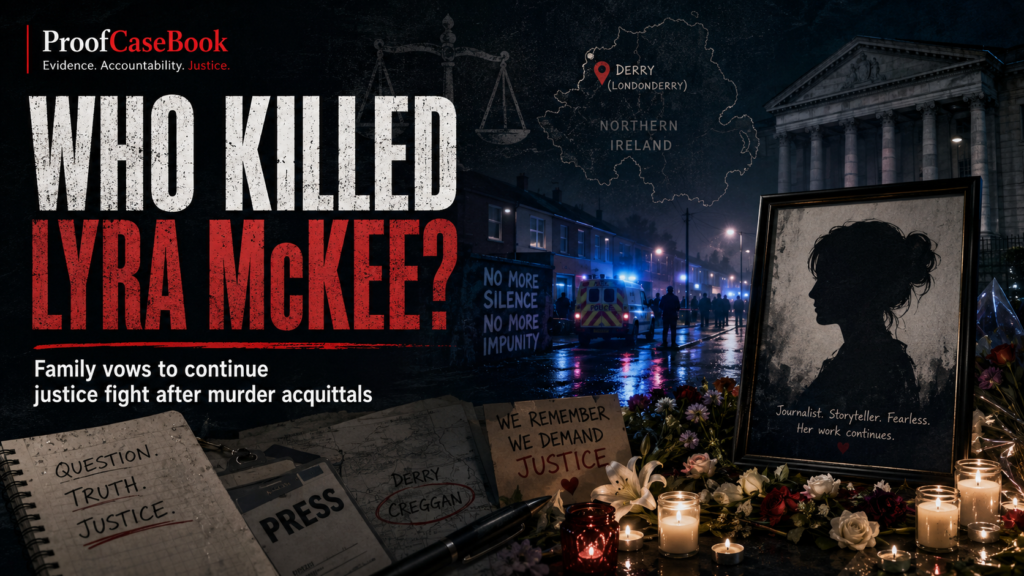
Legal note: Paul McIntyre, Jordan Devine and Peter Gearoid Cavanagh were found not guilty of Lyra McKee’s murder. They must not be described or treated as responsible for her death. The individual who fired the fatal shot has not been brought before a court.
More than seven years after journalist Lyra McKee was shot dead during disorder in Derry, the most important question remains unanswered:
Who pulled the trigger?
On 3 July 2026, three men accused of assisting or encouraging the gunman were acquitted at Belfast Crown Court. None of them had been accused of firing the fatal shot. The judgment left Lyra’s family devastated and returned the investigation to its central unresolved problem: the person who killed her has still not faced justice.
But the case has not been closed.
On 31 July 2026, the Police Service of Northern Ireland renewed its appeal for information. Crimestoppers also offered a reward of up to £20,000 for information leading to the arrest and conviction of those responsible. Detectives specifically appealed for information that could identify the gunman.
For Lyra’s family, the renewed appeal represents another stage in a fight they have repeatedly said they will not abandon.
A young journalist caught in an act of violence
Lyra McKee was 29 when she was fatally shot on 18 April 2019.
She was observing disorder in the Creggan area of Derry, close to police vehicles, when shots were fired towards police officers. One of the bullets struck Lyra, fatally injuring her. The New IRA later claimed responsibility for the killing.
The court subsequently found that the gunman intended to kill or cause really serious injury to police officers. Under the legal principle of transferred malice, the fact that Lyra rather than an officer was struck did not make her death accidental in law. The court concluded that she had been murdered.
Lyra was not participating in the violence. She was a journalist watching events unfold in a community she had come to call home.
Originally from Belfast, she had moved to Derry to live with her partner, Sara Canning. She had attracted attention through her writing on Northern Ireland, its unresolved past and the experience of growing up gay in Belfast. The National Union of Journalists regarded her as a talented and promising journalist.
Her death caused outrage across Northern Ireland and beyond. Yet public condemnation has not produced the evidence required to identify and convict the person who fired the gun.
What were the three men accused of doing?
Paul McIntyre, Jordan Devine and Peter Gearoid Cavanagh were not prosecuted on the allegation that any of them had pulled the trigger.
The prosecution alleged that they were masked individuals who accompanied the gunman and intentionally assisted or encouraged him. The murder charges were therefore based on the law of secondary responsibility, sometimes referred to as joint enterprise.
The case relied entirely on circumstantial evidence. This included video recordings, imagery analysis, mobile-phone and cell-site evidence, DNA material, associations between individuals and other evidence collected during the investigation.
The trial began in 2024 and continued for approximately two years before Mrs Justice Smyth, sitting without a jury.
In February 2026, the judge rejected applications arguing that there was no case for the defendants to answer. That meant the prosecution had presented enough evidence for the trial to continue. It did not mean that guilt had already been established.
That distinction became critical when the final verdicts were delivered.
Why were the men acquitted?
To convict someone of murder, the court must be satisfied of guilt beyond reasonable doubt.
Suspicion, association or the possibility that a person may have been involved is not enough.
In Peter Cavanagh’s case, the court found that the DNA, cell-site and imagery evidence did not prove beyond reasonable doubt that he had intentionally assisted or encouraged the gunman.
For Paul McIntyre and Jordan Devine, the judge concluded that the quality of the mobile-phone footage was too poor to identify them reliably as the masked people accompanying the shooter. Similar clothing and appearance could not exclude the possibility of coincidence.
All three were therefore acquitted of murder. The murder and firearms-related charges against the defendants in the wider proceedings also ended in acquittals.
The trial produced two convictions on other matters. Christopher Gillen was convicted of riot and petrol-bomb offences connected with the events of 18 April 2019, while Kieran McCool was convicted of common assault against a community worker. Neither conviction established responsibility for Lyra’s murder.
The verdicts must be respected. An acquittal is not permission to continue accusing the people who were cleared.
At the same time, the acquittals did not answer the question of who shot Lyra.
An acquittal is not the same as solving the murder
There is an important difference between saying that a murder occurred and proving who was criminally responsible for it.
The court was satisfied that Lyra was murdered. It was not satisfied that the prosecution had proved the murder charges against the three defendants.
That does not represent a contradiction. It reflects the burden of proof required in a criminal court.
The Public Prosecution Service said that its decision to bring the case had met the legal test for prosecution and was in the public interest. However, the test used when deciding whether to prosecute is different from the higher standard a court must apply before convicting someone.
This distinction may offer little comfort to Lyra’s family. They endured years of investigation and a lengthy trial only to discover that the person who fired the shot was still outside the courtroom.
Nevertheless, justice cannot be achieved by lowering the standard of proof or blaming people whom the court has cleared. A wrongful conviction would not provide genuine justice for Lyra.
The proper response is to continue searching for credible evidence against the person or people actually responsible.
The family says its fight is not over
After the acquittals, Lyra’s sister Nichola Corner and her former partner Sara Canning said they would continue trying to identify the gunman and anyone who helped conceal his identity.
They believe that people within the community know more than they have disclosed.
Nichola described the family as being forced back to the beginning of a long struggle. She also said the family had promised Lyra’s mother, who died less than a year after her daughter, that they would continue fighting for justice.
Their anger is directed not only towards the unidentified gunman but also towards what they see as a continuing refusal by witnesses to speak.
The family has referred to a “culture of silence” surrounding the case. Nichola said that more than 150 people had witnessed the events that night, yet no one had provided the evidence necessary to identify and convict the killer.
That claim raises a painful question.
How can a murder committed in front of a crowd remain unsolved for more than seven years?
Fear, loyalty and the culture of silence
People may refuse to speak to police for many reasons.
Some may fear retaliation. Others may distrust law-enforcement institutions. Some may feel loyalty towards individuals or organisations involved in the disorder. There may also be witnesses who believe that what they saw was too limited to be useful.
But silence has consequences.
When witnesses with meaningful information remain silent, they do not simply obstruct the police. They deny a grieving family the possibility of learning the truth.
They also create an environment in which armed organisations can act without accountability.
The New IRA claimed responsibility for Lyra’s death, but an organisation’s admission does not identify the person who fired the weapon or everyone who assisted in the act and its concealment.
A community cannot reject a killing publicly while privately protecting the people responsible for it.
Anyone who knows the gunman’s identity, where the weapon came from, how he escaped or who helped hide evidence possesses information that could transform the investigation.
The renewed £20,000 appeal
The latest police appeal shows that the investigation remains active.
On 31 July 2026, Detective Chief Inspector Hazel Miller said investigators were particularly seeking information about the gunman. She acknowledged that some people might be frightened or reluctant to speak but argued that circumstances and allegiances can change over time.
Crimestoppers is offering up to £20,000 for information provided directly to the charity that results in the arrest and conviction of those responsible.
The charity allows information to be provided anonymously. It states that calls are not recorded, callers’ numbers are not displayed and computer IP addresses are not traced. Information may also be supplied directly to the PSNI.
The reward cannot replace moral responsibility. However, it may persuade someone who has remained silent since 2019 to reconsider.
Seven years is a long time, but relationships change. Loyalties weaken. Fear can diminish. People who once believed they were protecting a cause may eventually recognise that they were protecting a killer.
Questions that still require answers
The renewed investigation must attempt to establish:
- Who fired the shots towards the police vehicles?
- Who supplied or transported the firearm?
- Who accompanied the gunman before, during and after the shooting?
- How did the shooter leave the area?
- Did anyone hide the gun, clothing, digital evidence or other material?
- Who knew the gunman’s identity but deliberately withheld it?
- Can modern forensic or digital techniques reveal information that earlier examinations missed?
- What protection can be offered to witnesses who genuinely fear retaliation?
The police must also examine whether every available recording, photograph, phone record and piece of forensic evidence has been fully reassessed.
Technology has improved since 2019. Evidence previously considered unclear may benefit from further expert review, although investigators must remain careful not to exaggerate what poor-quality footage can reliably prove.
The failure of the prosecution case demonstrates the danger of building accusations around uncertain identification evidence. Any future charge must be supported by evidence strong enough to withstand detailed examination in court.
Justice must respect the acquittals
Public frustration must not be redirected towards the three men who were found not guilty.
The court examined the evidence against them and concluded that it did not establish guilt beyond reasonable doubt. Calling them murderers after their acquittals would be unfair and potentially unlawful.
Lyra’s family deserves justice, but justice has two sides.
It requires the guilty to be held accountable, and it requires people who have not been proved guilty to remain protected from punishment and public condemnation.
The responsibility now lies with investigators to find new and reliable evidence rather than attempting to revive allegations that have already failed without a lawful basis for doing so.
The killing of a journalist affects everyone
Lyra’s murder was not only a tragedy for her family and friends.
The killing of a journalist creates fear far beyond one individual. Journalists must be able to observe unrest, investigate powerful organisations and report on divided communities without becoming targets of violence.
The National Union of Journalists has said it remains deeply concerned that the person who fired the shot has never been charged. The organisation has welcomed the renewed police appeal and called for continued efforts to secure accountability.
When the murder of a journalist remains unresolved, it sends a dangerous message that violence can silence reporting without consequence.
That is why this case should concern everyone who values truth, public accountability and freedom of the press.
Who killed Lyra McKee?
The honest answer is that the identity of Lyra McKee’s killer has not been established in court.
The New IRA claimed responsibility for the shooting. The court concluded that Lyra had been murdered. Three men accused of assisting or encouraging the gunman were prosecuted and acquitted. The person who pulled the trigger has not been brought before a judge.
Lyra’s family has every right to continue demanding answers.
The police have a responsibility to continue investigating. Anyone with material information has a moral responsibility to consider the pain caused by remaining silent.
Justice must not mean finding someone to blame. It must mean identifying the right person through reliable evidence and proving the case lawfully.
Until that happens, the central question will remain:
Who killed Lyra McKee—and who is still protecting the truth?
You may also like this article: