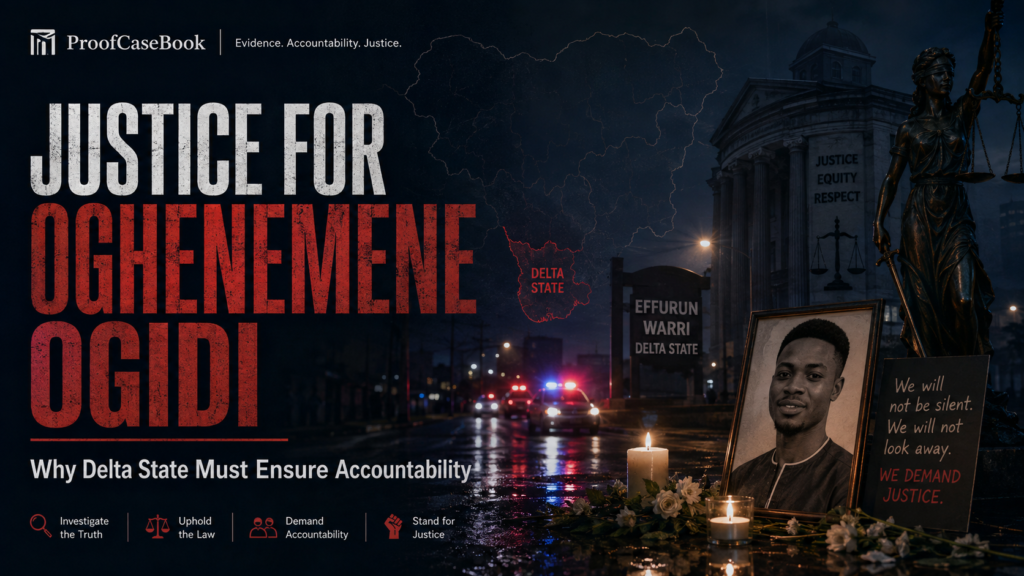
Editorial note: Criminal proceedings are ongoing. The dismissed officers accused in connection with Oghenemene Ogidi’s death have pleaded not guilty and must be presumed innocent unless convicted by a court. This article calls for a transparent trial and accountability; it does not determine the individual guilt of any defendant.
The killing of 28-year-old Oghenemene “Mene” Ogidi in Effurun, Delta State, has raised disturbing questions about police power, citizens’ rights and the responsibility of the government to protect human life.
Ogidi was not killed during a court-authorised execution. He was not standing before a judge, and no court had convicted him of an offence. According to the account later presented by the Nigeria Police Force, he had already been apprehended and was unarmed when he was fatally shot on 26 April 2026.
The police said a parcel connected to Ogidi contained a fabricated Beretta pistol and four rounds of ammunition. But the Force also stated that no criminal suspicion, regardless of its seriousness, justified extrajudicial action and that every suspect was entitled to due process.
That distinction is central to this case.
Even where officers reasonably suspect that someone has committed a serious crime, their responsibility is to arrest, investigate and present that person before a court. Police officers are not investigators, judges and executioners combined.
A video that left Nigerians demanding answers
Public anger intensified after a video associated with the incident circulated online. The footage reportedly showed Ogidi restrained before the fatal shooting, causing many Nigerians to question why lethal force was considered necessary against someone who appeared to have already been brought under control.
The case rapidly became more than a local tragedy. It became another test of whether an officer accused of unlawfully taking a citizen’s life would face the same justice system that ordinary Nigerians are expected to respect.
Following an internal investigation, the Police Service Commission approved the dismissal of officers implicated in the incident. The police subsequently forwarded the case file for prosecution and stated that the officers’ alleged conduct involved professional misconduct, abuse of office and violations of the rules governing police operations.
On 2 June 2026, the Delta State High Court in Asaba remanded Assistant Superintendent of Police Usman Nuhu and four other dismissed officers at the Ogwashi-Uku Correctional Centre. The proceedings are listed under Charge No. DTHC/ASB/CR/M/66/2026 before Justice Marshall Onome Umukoro.
Their appearance before a court is an important beginning. It is not, by itself, the completion of justice.
Suspicion is not a death sentence
One of the most dangerous arguments that can arise in cases like this is that the discovery of a weapon somehow removes the victim’s right to life or due process.
It does not.
The content of the parcel deserved a thorough criminal investigation. Authorities needed to determine who sent it, who owned the alleged weapon, where it came from and whether Ogidi knew what he was transporting.
Those questions should have been answered through evidence, interviews, forensic examination and judicial proceedings.
A suspect who is alive can assist investigators. He can identify other people involved, challenge the evidence against him and present his own account before a court. A dead suspect cannot do any of those things.
The Nigerian Constitution protects the right to life, while the Nigeria Police Act identifies the protection of lives and property as one of the Force’s fundamental responsibilities.
The uniform therefore confers authority, but it does not grant permission to take life outside the law.
Delta State cannot treat this as somebody else’s problem
The Nigeria Police Force is a federal institution, and the Delta State Government does not exercise complete operational control over police officers. That constitutional reality must be acknowledged.
However, it does not release the state government from its responsibility to protect residents and pursue accountability when a person is killed within its territory.
Governor Sheriff Oborevwori publicly condemned Ogidi’s killing and demanded swift justice. That statement was necessary, but the government’s responsibility cannot end with condemnation.
Delta State authorities should:
- ensure that the prosecution receives the institutional support required to conduct the case properly;
- provide clear public updates without interfering with the independence of the court;
- ensure that witnesses are protected against intimidation;
- support the victim’s family in accessing information and legal representation;
- preserve all video, forensic, medical and documentary evidence;
- resist any attempt to delay, weaken or quietly abandon the proceedings.
The security and welfare of citizens are fundamental responsibilities of the government. Residents should not have to wonder whether the people carrying government-issued weapons are there to protect them or place them in danger.
Delta State must therefore demonstrate—through action rather than promises—that every life within the state matters.
The accused officers must remain available to face justice
The officers accused in this case must not be shielded, hidden or quietly released from public accountability.
Dismissal from the police is an administrative punishment. It does not replace criminal prosecution where the available evidence indicates that a criminal offence may have occurred.
The court must be allowed to determine the responsibility of each defendant. This includes identifying who allegedly fired the fatal shot, who supplied assistance, who failed to intervene, what instructions were given and whether anyone subsequently attempted to alter evidence or misrepresent the circumstances of the killing.
At the same time, accountability must be based on evidence. It would be wrong to treat every officer present as automatically having the same degree of criminal responsibility. The prosecution must prove its allegations against each person individually.
Justice demands neither mob punishment nor institutional protection. It demands an open, competent and impartial judicial process.
Questions that must not disappear from public attention
As the case proceeds, several important questions require clear answers:
- What did the officers know when they arrived at the scene?
- Was Ogidi restrained and under effective police control when he was shot?
- Did he pose an immediate threat to any officer or member of the public?
- Who authorised or participated in the use of lethal force?
- What actions did the other officers take before, during and after the shooting?
- Was the alleged weapon properly recovered, documented and subjected to forensic examination?
- Have investigators identified the sender and intended recipient of the parcel?
- Were all original recordings of the incident preserved without alteration?
- What measures are being taken to protect witnesses?
- Will the public receive regular and accurate information as the trial progresses?
These are not questions designed to interfere with the court. They are questions necessary for maintaining public confidence in the administration of justice.
Justice must include the family left behind
Public discussion often concentrates on the officers, the video and the court proceedings. But behind the headlines is a family that lost a son.
No prosecution can restore Ogidi’s life. Nevertheless, his family deserves truthful answers, respectful treatment and the assurance that the case will not be forgotten when public attention moves elsewhere.
They should not have to fight endlessly for access to official information. They should not be pressured into silence, and they should not discover major developments through social media.
Where state institutions are involved in a citizen’s death, those institutions owe the bereaved family a particularly high level of transparency.
One prosecution will not solve police brutality
Holding the accused officers accountable is necessary, but Nigeria must also confront the wider institutional conditions that allow abuse to continue.
Police reform should include stronger screening during recruitment, regular psychological evaluations, enforceable rules on firearm use, improved human-rights training and reliable body-camera systems for armed operations.
Supervising officers must also be held responsible when they ignore repeated misconduct by personnel under their command.
An institution cannot restore public trust simply by describing every serious incident as the work of a few “bad officers.” It must demonstrate that warning signs are identified, complaints are investigated and dangerous personnel are removed before another life is lost.
Justice must be visible
The Oghenemene Ogidi case is now a test for the Nigeria Police Force, the Delta State Government, prosecutors and the judiciary.
The police have dismissed implicated officers. The accused have been brought before a court and remanded. These are significant steps. But Nigerians have seen cases begin with strong statements and public outrage, only to disappear into prolonged adjournments and official silence.
That must not happen here.
The proceedings should be prompt, transparent and based on credible evidence. Any officer found guilty must face the full consequences prescribed by law. Any defendant against whom the allegations cannot be proved must also receive the protection of due process.
Justice for Oghenemene Ogidi does not require revenge. It requires the clear application of the law without fear, favour or protection based on uniform or rank.
Delta State must remain actively committed to protecting its residents, supporting the judicial process and ensuring that this case reaches a lawful conclusion.
A police uniform must never become a shield against accountability. No public official should possess the power to decide—at the roadside and without trial—who deserves to live.
You will also like this article: